student

doctorate education gamification phd pokemon effect triforce

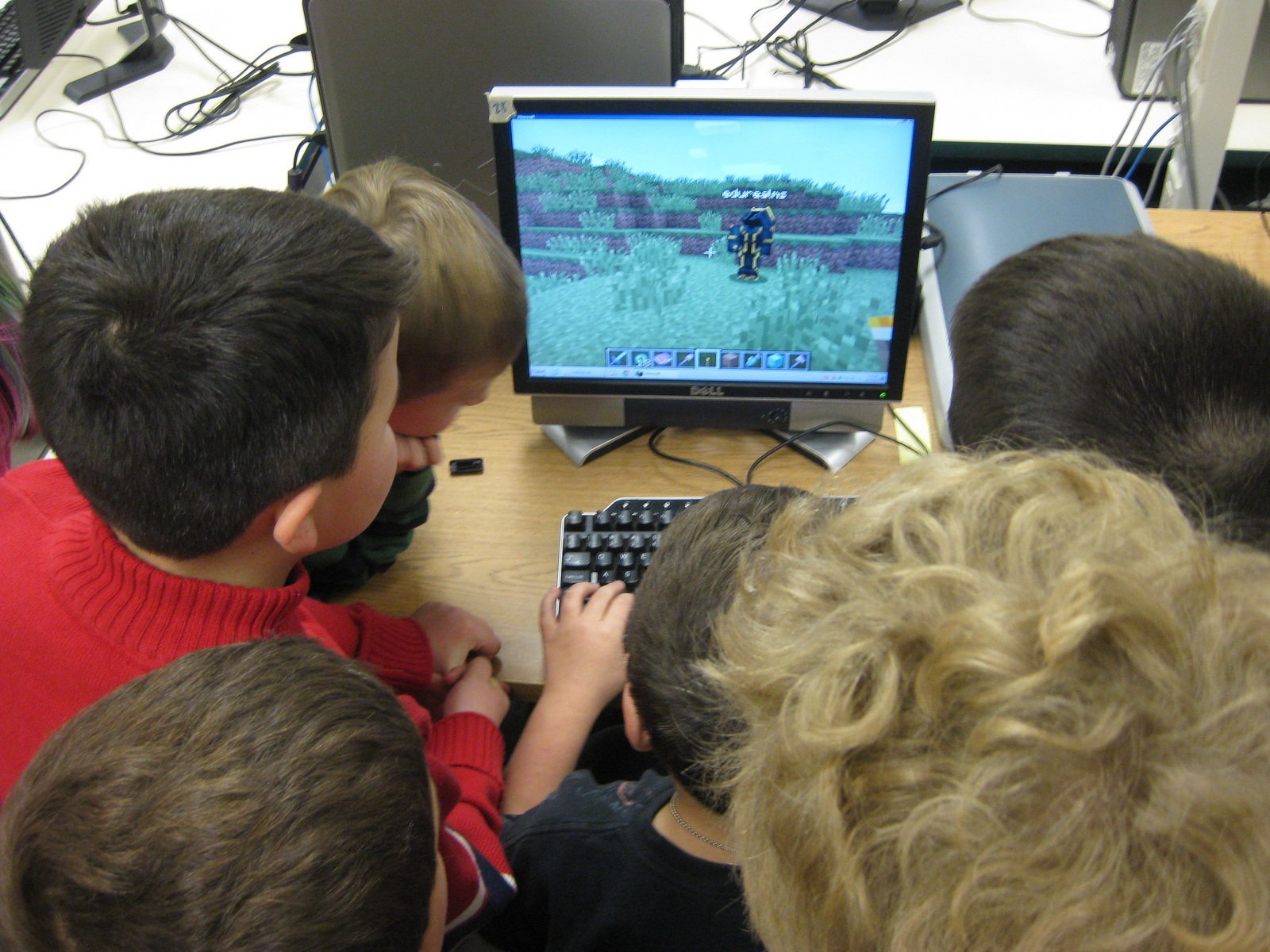
Minecraft: The cornerstone of future education?

image26

Why the indie success should continue to be used as a learning tool in schools.

A lot has been mentioned about Minecraft’s benefit in learning. However it’s rare to hear about Minecraft and learning from a students’ point of view. Students are starting to see the potential of combining their love of gaming and the opportunity to learn in a way which is both motivating and relevant. What does the future hold for games like Minecraft? Is it possible that Minecraft will one day be a part of the common core, or government mandated national curriculum?

http://planetivy.com/gaming/43886/minecraft-the-cornerstone-of-future-education/

doctorate education gamification phd pokemon effect triforce

Teachers want access to more technology in the classroom

Teachers want access to more technology in the classroom

A nation wide survey conducted last year discovered that teachers want more technology in the classroom. Access to computers seems to be high and a lot of teachers are using websites, images and other media in their daily classroom routine.

However the problem, according to the survey, is that teachers feel they don’t have access to the “right” kinds of technology. The biggest barrier to technology, unsurprisingly, was budget constraints.

Teachers have their hearts in the right place. Most teachers cite ‘motivating students’ as their reason for wanting more technology in the classroom.

What surprised me was that 943% of teachers believed that interactive whiteboards ‘enrich’ classroom education. I understand the limitations of classroom technology and also the often low levels of training teachers have in using technology in the classroom. Particularly, teachers aren’t always well versed in areas like the internet and social media. However, I cannot fathom why interactive whiteboards (a 20+ year old technology) is still desired in a classroom environment.  I had access to them over 10 years ago and nobody in my school was interested in using them. Their application, quite honestly, is limited.

Overcoming budget is an understandable problem. One idea might be to apply a BYOT (bring your own technology) attitude. Allowing students to bring mobile devices to class – and use them directly for learning – will help raise motivation levels. Also, students are more likely to enjoy using computers (internet and social media) than they are using interactive whiteboards.

Teachers should start moving towards a more participatory methodology for learning. Provide students with the basic ideas or questions and let them use the resources that they’re comfortable with (online environments) and it might be surprising what they can produce.

Perhaps the problem in modern education is that we’re too focused on telling students what tools they can use to solve problems (such as learning, knowledge acquisition and skills building). Instead, let them choose their own tools. Why can’t a pyramid be modeled in Minecraft? Why can’t student presentations be done via youtube?

The best part is that teachers don’t even have to think of tools that students might choose. Students will do that! Technology? Not a problem, students will use the technology they have and whatever they’re comfortable with. Teenagers are happy to work when doing so on their own terms. Whatever students are studying, just give them core ideas and let them figure out the rest. Study after study proves that student will work when they work for themselves.

Motivation goes up. Creativity goes up. Original content and content creation goes up … all without the teacher lifting a finger.

Win!
doctorate education gamification phd pokemon effect triforce

Does Game Based Learning Work?

Does Game Based Learning Work? Short answer: Yes. Blunt’s analysis of three studies draws together enough empirical data to suggest that there is a correlation between gaming and test scores.

The idea of the study was simply to discover whether COTS (commercial, off-the shelf) games facilitate improved learning in a classroom environment. The results strongly suggest that there’s benefits to combining gaming and learning. Blunt used a theoretical framework which considered multiple concepts:

  • ARCS (attention, relevance, confidence, satisfaction). This model identifies four areas in which learning is broken into parts. The theory is that students require motivation as well as practical examples of how a system works (which the students can use to help their understanding).
  • Good Video Game Design. Of particular importance is the computer game’s quality. The game must have rules (restrictions and generic codes), goals & objectives, be challenging and be engaging.

Blunt conducted three separate studies at a university level. All of the subjects were business related – business, economics, management. Each subject had a corresponding COTS computer game which fit the curriculum. As a study control, the subjects that were chosen had two or more class groups. One group was allowed to play computer games as a part of the curriculum, the other class (which was learning exactly the same content) didn’t have access to a computer game – ie it was a standard class. At the end of the course, students were given standardised tests.

The results were very encouraging. The classes which included computer games had a much higher average score and more “A” level results than classes without the games. Also, classes with computer games had no students fail the course, while the other classes had a number of fails. The results also considered other matrices such as gender and ethnicity. Overall, computer games seemed to have almost no discernible affect on gender or ethnicity. The only other significant factor was age. Students under 40 years of age performed significantly better with computer games. Students over 41 didn’t benefit from using computer games in class.

Blunt concludes that his results are significant, however the problem he is trying to address is the lack of empirical data which can be used to prove a causal-comparative relationship between computer games and learning.

Simulations. We have plenty of empirical studies about simulations over the last 25 years. We know simulations work. We know simulations improve performance. We know simulations improve learning. Yet, I challenge anyone to show me a literature review of empirical studies about game- based learning. There are none. We are charging head-long into game-based learning without knowing if it works or not. We need studies. – Dr J. Cannon-Bowers

doctorate education gamification phd pokemon effect triforce

Findings from the Teaching, Learning, and Computing Survey: Is Larry Cuban Right?

Findings from the Teaching, Learning, and Computing Survey: Is Larry Cuban Right?

Note: This article links directly to a PDF file.

Becker attempts to review Cuban’s initial findings that computers are largely incompatible with classroom teaching. His data, 16 years after Cuban’s initial study, asserts that there are conditions under which the likelihood of computer usage can dramatically increase.

However, I was unable to agree with Becker’s views. He did find Cuban’s assertions to still be correct.  Becker claimed, though, that computer usage could improve. My issue with this finding that there were too many caveats required to satisfy Becker’s claims. He stated that a classroom needed at least 5 computers and all students needed an average amount of technical skill. As well, the teacher needs to be highly proficient in using constructionist teaching pedagogy. 

While this may not be too difficult to accomplish, there are too many “ifs” to be satisfied. If the computers are fully functional and all software is up-to-date. If teachers have time to write a computer based curriculum. If time within the curriculum permits computer usage (as all teachers know, computer-based tasks take longer). If the teacher is skilled in developing curriculum that can maximise learning using computers.

Once all those “ifs” can be satisfied, then perhaps computers can make a dramatic difference in classroom education. However it’s still a case of shoehorning computers into classrooms. 

doctorate education gamification phd pokemon effect triforce

How about flipping the school instead?

How about flipping the school instead?

The idea of flipping the classroom, albeit new, has become a somewhat cliched concept already. Teachers talk about how the classroom can be radically changed by using the internet to change the way we teach. I’m not deriding this methodology. In fact, I agree it has its merits – in that it illustrates education’s willingness to change. 

However the entrenched problem of the system itself still remains. Why are children sitting in a classroom, isolated from each other by computer screens? They are learning but what’s the point of traveling all the way to school to get on the internet? 

While some would say that the 1-on-1 tutoring and contact with the teacher is the key ingredient, it doesn’t really answer the question. Students can get that assistance in other ways, such as by a teacher on a webcam (perhaps using Google hangouts). The teacher could use a shared drawing space app to draw and write problems which the student could see while listening to the teacher’s explanation. The teacher could also refer the student to a different instructional video. Another approach would be to have students conference together and explain to each other. Or just use a dedicated forum to ask for help. The student, as well as learning about a math problem, could be learning online interaction skills and research skills while they find the answer to the problem.

Finally, the student could also be getting help from their *gasp* parents in finding ways to solve problems or answer questions they don’t understand.

Flipping the classroom is great … but it’s still a classroom. Technology has always been shoehorned into schools for more political benefit than educational benefit. Kids are learning more online away from classrooms (and away from formal education) than ever. Teachers should not be instructors. They should become a guide, a sounding board or even a safety net for when students need a boost.

Flip the education system. Remove the classroom from the picture and see how quickly kids adapt to an education that they control.

The rise of social learning …

Scroll to Top