gaming

doctorate education gamification phd pokemon effect triforce

Even JK Rowling plays Minecraft

Screen Shot 2015-01-19 at 10.11.06 pm

As a fun little follow up to a recent post about celebrities playing Minecraft, JK Rowling today tweeted that she’s working on a book but is distracted by other interests – including Minecraft. This, of course, caused a stir amongst the Minecraft fanbase. If I had to guess what Ms Rowling’s favourite activity is while she’s playing Minecraft, my guess would be … enchanting!

doctorate education gamification phd pokemon effect triforce

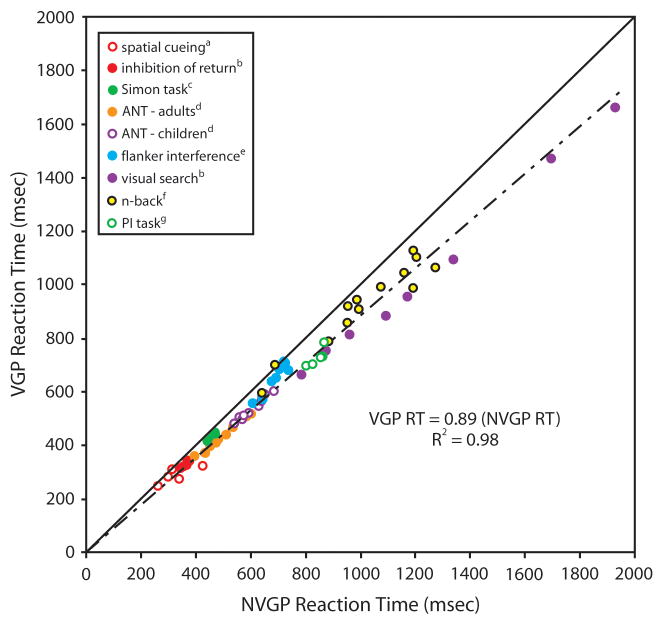
Solid evidence that gaming improves perception and motor skills – and that skills are transferable!

Fig. 1

Diagram from here: http://www.ncbi.nlm.nih.gov/pmc/articles/PMC2871325/

Some excellent studies have shown the value gaming has in motor skills, perception and decision making. Dye, Shawn Green and Bavelier have spent a number of years continuously experimenting and improving on their research surrounding whether people’s ability to make decisions or perceive things is affected by games. The overwhelming result is that gaming does have a significant impact on certain skills. Of particular interest is the conclusion drawn that, from these experiments, the assumption can be made that skills learned during gaming are transferable … a critical issue in education and learning fields.

One area that is confirmed to be improved is the ability to pay attention (attentional capacity) during an activity. Gamers have a longer attention span and can focus better on a task and improved results (accuracy).

Most interestingly, the study didn’t just conclude that gaming improves visual attention skills. As a second experiment, participants were divided into groups to play two different games. One group played an ‘action game’ called Medal of Honor. The other group played Tetris. Both groups achieved better results on the tests than groups which didn’t play video games as a ‘training’ tool. Most interestingly, the participants who played Medal of Honor did better than the participants who played Tetris.

The study was able to conclude that 10 days of action game training is sufficient to increase visual attention capacities. Further, action video game playing pushes the limits of different areas of visual attention. The researchers argue that the nature of games and the inherent visual multitasking provides significant visual skill training.

http://www.nature.com/nature/journal/v423/n6939/full/nature01647.html (paywall article, sorry)

http://www.ncbi.nlm.nih.gov/pmc/articles/PMC2871325/

http://greenlab.psych.wisc.edu/documents/Perceptual-Learning-During-Action-Video-Game-Playing(Green-Li-Bavelier-2010).pdf

doctorate education gamification phd pokemon effect triforce

Creating is Learning: Building skills and knowledge through Minecraft

http://www.youtube.com/watch?v=vFuULAE6RfU

Creating is Learning: Building skills and knowledge through Minecraft.

Computer games are fun and gaming is an important aspect of digital culture. The best part about computer games is that when we play, we learn!

This video was made as part of my Masters in Education studies at Griffith University, Queensland, Australia.

Full references, citations and the supporting paper can be found here:

http://griffith.academia.edu/DavidSmeaton

Contact me or learn more about my other videos, studies and academic writing.

about.me/davidsmeaton
davidsmeaton.wordpress.com

Thanks to Notch and Mojang for making such an excellent game. Thanks also to the Minecraft community (particularly /r/minecraft) and the people who have developed original content that I used in my video.

doctorate education gamification phd pokemon effect triforce

More hate for gamification

More hate for gamification

The problem with “critics” is that they’ve got lots of opinions … but don’t usually contribute anything productive (other than their verbosity) to the discussion. The problem with gamification is that it has become so popular so fast that critics are lining up to take a swipe and feel good about themselves.

Margaret Robinson’s article from 2010 on gamification goes down the same road as many other critics, including Bogost’s scathing attack (mentioned in the previous post). Robinson is determined that gamification focuses on the least important part of the game. She, like Bogost, says that badges and progress points aren’t intrinsic to the game at all.

But she’s wrong … they are important. Gamification isn’t about the game itself. Gamification is about how a game layer (game elements) can be used as motivators. If we look directly at games we can confidently say that games have motivators. One motivation is to win, to be the best. That motivation is represented by a scoreboard (leader boards can be used as a gamifying technique). If there’s no score or no winner, then many will find the game to be less fun.

Let’s make it more clear through an example. I’m a bit of a poker player. I enjoy poker and I play it when I can. It’s possible to play poker without money and without talking to the other players. But doing so would take away most of the fun … it would take away the motivation to play. See, that’s an intrinsic part of gaming. Sometimes the game itself is not that interesting, but socialising and gambling add to the enjoyment. I play poker so that I can experience the adrenaline rush of winning a big hand and, at the same time, talking with friends over a few beers.

Sometimes the game is just a tool. The mechanics of the game are not that important. This is what gamification represents. If we add a game layer to other tasks then we add a motivation. Gamification includes rewards, and it also includes socialising.

http://www.slate.com/articles/technology/gaming/2011/03/i_dont_want_to_be_a_superhero.html

More criticism. This time targeted at gaming guru Jane McGonigal. Through her Tedx talk, McGonigal talks about her heal and some experiences relating to that. Particularly she relates how she used gamification and roleplaying to help her recovery. 

Heather Chaplin, the author of the piece, says that games aren’t that fun and “gaming” isn’t for everyone. This is another common criticism of gaming and gamification – it isn’t a one-size-fits-all solution.

Well, no … of course not! Nobody who is a proponent of gamification is saying such a thing.

The truth is that we all DO play games. We play various games in our daily lives. Some people play cards, some collect coupons or air miles. Some play sport and others play tetris on their smartphone. Everyone plays games … but not everyone plays the same type of game. That’s not the same as saying not everyone finds games appealing, which is a falsehood.

Gamification covers this problem too by acknowledging multiple approaches to motivating people to play. Level up systems, for example, are a combination of small (like an incremental number) and big (like a major “level”). This is important because some people are motivated by different goals. Some people like to see the incremental gains (immediate, short term goals) and others prefer the larger gains (long term goals). Both work together to motivate. The same with leaderboards – global leaderboards motivate those who wish to be the best. Social leaderboards motivate people who want to try and beat their friends. Some people are motivated by certain badges. Others are motivated by completely different goals or achievements such as social status.

A great “real world” example is scouts. Scouts get badges for proving that they have a certain skill. Once they demonstrate a skill they get a patch or badge. The badges give a scout status in the community (global leaderboard) and amongst their friends (social leaderboard). When the scout gets a certain number of badges they can get a promotion (level up). 

All of these ideas are older than the internet and computers. Gamification isn’t creating something new, it’s just identifying systems and motivational strategies that have been around for centuries.

The main criticisms of gamification is that it doesn’t focus on the most important part of the game (ie the actual game) and that games don’t appeal to everyone. 

Complete rubbish! The game and the rewards for playing are equally important. Everyone is motivated by different rewards, so gamification is a multi-faceted approach which acknowledges such. Finally, whether critics want to admit it or not, everyone DOES play games. Grandma may not play shooter games like Call Of Duty, but she does collect the supermarket discount stamps (that’s a game) and she does play bridge on Thursdays (another game). She doesn’t collect stamps because she thinks its fun (it’s not fun at all). She collects the stamps because there’s a reward (free stuff). She doesn’t play bridge because she enjoys the technicalities and math involved in the game. She plays because she can chat with her friends and is motivated to beat them (and win status as a good player).

See, gamification is everywhere. 

It’s too easy to criticise something because it’s popular. It’s much harder to take a more measured approach to understanding that gamification offers real potential in education. Games and gamification are valid tools for motivating people to participate and learn … it’s sad that we still have to fight this war over justifying the place of gaming in our culture.

doctorate education gamification phd pokemon effect triforce

A New Culture Of Learning

A New Culture Of Learning

John Seely Brown is quickly becoming a bit of an academic rolemodel for me. The ideas he presents are in step with my own thinking. My research is going to look closely at his works and apply some of his theories directly to gaming – particularly Minecraft. Brown and Thomas’ book is an exploration on learning in the digital environment. Arc-of-LIfe Learning – Brown begins his exploration by looking at some examples of learning. A few case studies are used as an illustration of how learning has been achieved beyond educational institutes. Kids and adults have shown that they are learning through interaction, discovery and having fun.

Briefly, A New Culture Of Learning begins with some discussion about culture and how culture shifts due to technology’s influence. Traditional ideas (such as the classroom) are a mechanist approach where learning is a series of steps to be mastered. The focus is on the end result, the product, not the process of learning. This view is obsolete and, according to the book, a more environmental view (including digital networks) should be taken. These learning environments promote a more organic learning process. The crux of this book is the very idea that technology has created an avenue for a new culture of learning to develop; a more environmental, holistic learning approach with technology as an ingrained part of that learning.

To achieve this goal, there must be change. The infrastructure of the internet has grown exponentially faster than any technology advances before it. The biggest realisation is that culture has changed from static (information as a one way street) to a participatory medium. Information shifts and changes as we interact with it, share it and remix it across the internet. We participate and interact with knowledge in a way that has never been possible before.

The result is a new way of learning. Through play and imagination we can change how we think of the learning process. No more memorising. Instead, information absorption through the process of engaging with information and the world around us. Playing is a powerful learning tool.

Enter here the collective. I like this word … collective. It’s not community, it’s not collaboration. It’s more like bees in a hive. There’s a certain busy buzziness and “many as one” feeling to the word. The collective is a way to describe how we interact as online groups. The focus is on original content. Through peer-to-peer learning we can share and compare information and learn from each other. Skills and talents are unleashed as a kind of peer amplifier. From this emerges a collective in which we share knowledge and produce original content.  Creating and moulding information.

There’s no middle or core in a collective, and collectives improve with size and diversity (they scale well). participation doesn’t mean contribution but can be as simple as following a conversation, liking a blog post or “lurking” in a group that is creating something interesting. Collectives are innovative.

Indwelling

When a gamer plays a game hundreds of times they become familiar with the practices and ideas and processes of the game. It becomes engrained. The same happens with any form of action that is repeated continuously. This is referred to as indwelling – where a practice or idea becomes second nature. It’s an adaptive process, meaning that the habits learned are flexible and responsive to change. This relates to the notion of tacit knowledge, which comes from a lifetime of experience doing something which has become second nature. It’s knowledge that wasn’t explicitly learned, but has been acquired.

People who play games or spend time online are indwellers. They develop vast amounts of knowledge an information.

Gamer Disposition

As well as indwelling, gamers have a “gamer disposition”. This disposition is using resources and experimenting to find solutions to problems inside a game – such as a way to complete a task. However gamer disposition isn’t always about the most efficient way of completing a task. Sometimes gamers look for the most unique way, or elaborate way. Having solved the task already, they might repeat the task to complete it differently.  Sophisticated solutions are often preferred over routine ones.

Gamer disposition characteristics are

  • Keep an eye on the bottom line – gamers like to improve. They like to be evaluated and compared to other gamers. 
  • Understand the power of diversity – games require teamwork, so teams have a mix of talents and abilities. Gamers don’t think about how good they are but think about how good the group is and their role as part of that group.
  • Thrive on change – games aren’t static. If they were, gamers would lose interest quickly. The seek out change.
  • See learning as fun – this is a key characteristic. Games require learning and gamers love to learn the rules or systems involved in a game. As well, they love to solve puzzles and overcome obstacles (a core tenet of gaming). They convert knowledge into action.
  • Live on the edge –  gamers seek out alternative methods or strategies for completing tasks. They aren’t satisfied with mundane solutions, but try to find elaborate ways of finishing tasks. They desire to push the boundaries in order to discover something that deepens their understanding of the game.

Finally, Seely Brown and Thomas put together their thoughts in the form of knowing, making and playing. Experts know everything about their given topic. The understand the ‘what’ their topic is about. They don’t just know information, but they have a deep understanding (often through practice) of their area of knowledge. By doing something, such as hands-on activities, people are making. Building, creating content and making connections gives meaning to content and information. They are learning by doing. Finally, is the importance of play. The idea of ‘playing’ is a recurring theme in Seely Brown’s work. Through play we are able to discover and experiment, fail and test outcomes. It’s problem solving, or as Seely Brown explains it, riddling one’s way through a problem.

The world, they say, is constantly changing. This represents a state of flux which is a good thing. Flux inspires the challenge to learn and acquire knowledge. Through the many ideas brought together in the book (indwelling, playing to learn, collectives and imagination) the internet – and gaming – creates a space where new culture emerges. It’s a culture of collective inquiry that harnesses information and transforms it into something we can play and experiment with. This environment is a place which demands imagination because “where imaginations play, learning happens”.

Note: Due to time constrains, this is an abridged review and doesn’t encompass the entirety of the book.

Addendum: Apologies to readers of this blog who might have been mislead by any statements in this blog that have been poorly attributed; particularly the last comment “where imaginations play, learning happens”. When I wrote this book review, I didn’t use quotation marks around this statement, which implied that I had said it myself. This is not the case. I had simply forgotten to attribute it correctly. I have quoted other points from the book itself, but failed to quote this one (and also mis-quoted the authors by saying ‘imagination plays’ instead of ‘imaginations play’). This was unintentional. For a full reading of the twitter discussion that followed from a failure to correctly attribute a quote, see the pingback in comments below.

doctorate education gamification phd pokemon effect triforce

Three Papers by Jesper Juul

Three Papers by Jesper Juul – A brief synopsis of his recent works relating to computer game design.

*Note, all of the papers below are available for free from the Jesper Juul’s website (linked above).

Paper 1 – Zero-Player Games

Juul’s analysis of gaming looks closely at the players themselves and how player is defined. Importantly, the paper shows that there’s a distinction between games and gamers, and also, that games do not require a player (the player-centric model).

Zero-player games are games which require no significant human interaction for the game to be played. These are divided into four categories:

  1. Setup only games – games where the player starts the game and observes (without interaction) the remainder of the game.
  2. Games played by AIs – simply, games where the computer (AI) assumes the role of the player.
  3. Solved games – Games played by computers with the purpose of solving it – such as figuring out guaranteed winning moves, etc.
  4. Hypothetical games – non implemented games designed to describe or examine a question.

By understanding how games can be played without a player, paradoxically, the player can be more easily understood. Juul concludes with five distinct player traits:

  1. Players have continued agency
  2. Players as humans
  3. Players as temporal beings
  4. Players as having intentionality
  5. Players as having aesthetic preferences

Juul’s paper shows that a distinction can be made between game (artifact) and games (the activity). As well, it gives a strong rebuttal to the dominance of the player-centric model, since it doesn’t actually centre on players and overlooks their aesthetic preferences.

Paper 2 – Easy to use and incredibly difficult: On the mythical border between interface and gameplay

Interface and game play are seen, by many as Juul suggests, as vastly different. He argues that there’s no distinct border between the two. Interface is the tools (software and hardware) used to affect the game state. Gameplay is the core activity of the game.

The analysis focuses on defining the two elements and understanding how they have been used in game design. Importantly, Juul looks closely at the relationship between interface and gameplay, then compares their realisation in various games.

He concludes that gameplay is usually a simple premise or idea made challenging by the interface. The purpose of games is to be fun. Doing so often requires challenging the user. There’s a lot of fluidity between interface and gameplay. Because games are entertaining they are not always designed to be efficient. Intentionally adding inefficient elements to the gameplay or interface increases difficulty. This is a desired effect.

Most importantly, games provide an opportunity for the gamer to improve certain skills.

Blizzard uses the term skill differentiation to describe how requiring a range of skills allows a player to grow: a real time strategy game can have “twitch” skills, multitasking, strategic thinking, understanding of economy, knowledge of a map, and so on, as skill differentiators.

This means that difficulties of interface or gameplay simply become a skills hurdle for players to jump. The gameplay and interface in games is often blurred and, as games become more innovating, is redefined.

Paper 3 – The Fear of Failing? The many meanings of difficulty in video games

The role of failure in games is interesting and important to consider. Juul explores two important questions regarding failure.

  • What is the role of failure in games?
  • Do players prefer games where they do not feel responsible for failing?

There are two approaches to looking at “winning” in games.

  • Goal oriented – where the focus is on winning, which should be made as easy as possible
  • Aesthetic perspective – where there should be a reasonable combination of challenge and variation

Added to that are the methods of punishing players for failure.

  • Energy punishment – loss of energy, usually leading to life punishment
  • Life punishment – losing a “life”, usually bringing the player closer to game termination
  • Game termination – ending the game, forcing the player to start from the beginning
  • Setback punishment – making the player “replay” the game from a certain point

When a player fails, they might attribute the failure to three possible causes.

  • Personal – personal traits, skills or disposition (eg. I didn’t move fast enough)
  • Entity – the characteristics such as the game elements (eg. The enemy in game is too powerful)
  • Circumstance – luck, chance or other transient causes (eg. My fingers slipped off the controller)

Juul developed an empirical study, based on an earlier study by Malone in 1982, to test how players responded to different punishments (energy punishment and life punishment). The study concluded that players prefer to feel personally responsible for failure when they play a game. When players failed, then succeeded, they gave a higher rating for the game, reflecting that they felt more satisfied. This is in comparison to players who didn’t fail at all and players who failed too often (both groups gave less positive reviews of the game).

From the overall analysis, four observations were made about games and failure.

  1. The player does not want to fail (feels sad, inadequate)
  2. Failing makes the player reconsider their strategy (making the game more interesting)
  3. Winning provides gratification
  4. Winning without failing leads to dissatisfaction

This is an interesting outcome. Gamers want games to be difficult. While they hope to win, gamers will fail and feel personally responsible. Once they’ve reviewed their strategy and tried again, they will eventually win. The gamer feels gratification and is satisfied with the game.

Failure in games creates a sense of depth. Failure forces the player to re-evaluate strategies and practice their skills. Doing so reflects improvement and success (overcoming adversity).

A game should be neither too easy, nor too hard. Failure adds content!

doctorate education gamification phd pokemon effect triforce

High Score Education – Games, not school, are teaching kids to think.

High Score Education – Games, not school, are teaching kids to think.

Although somewhat dated, this short article by James Gee touches on some important elements of gaming and learning. The education system still pushes a “memorize and test” philosophy. Gee laments that children are not learning to think, they’re learning to memorise … and good students aren’t good at thinking they’re just good at “doing school”.

This is a very valid concern. Gee believes that games are an agent of mental training. That children aren’t meant to be memorising.

Learning isn’t about memorizing isolated facts. It’s about connecting and manipulating them.

I like that. It’s a very succinct way of describing what should be our relationship with information. This is exactly what the internet can do – provide an environment where we manipulate information by mixing, sharing and remixing between collectives online.

Gee states that the secret of video gaming’s success isn’t the games themselves or the 3D graphics, but the underlying architecture of the game. Each level is incrementally more difficult, pushing the gamer further and further beyond their abilities. This is the ‘regime of competence principal’. The game is just difficult enough to simultaneously provide pleasure and frustration for the player. It’s hard enough to be challenging, but through effort the player can be rewarded by winning the game.

Games also incorporate expertise. Gamers become masters of a game, but are then forced to adapt and evolve as the game becomes more complex.

As Gee notes, kids often say that playing games doesn’t feel like learning. They’re focused on playing. Again and again, educational experts push this point. Learning must become a secondary objective to having fun. When students are focused on having fun they forget that they’re also learning.

doctorate education gamification phd pokemon effect triforce

Assessing Higher Order Thinking in Video Games

Assessing Higher Order Thinking in Video Games

In his paper Assessing Higher Order Thinking In Video Games, John Rice draws the conclusion that educational computer games, such as Revolution, which was developed by MIT’s Media Lab (the game itself will be discussed in a future post).

With the increased global interest in gaming, educators are looking more closely at how computer games can be used in the classroom. Teachers seem to prefer edutainment style games which offer a “drill and kill” style of repetition practice. There is a wide spectrum of games being used (some ostensibly educational, some commercial but with educational potential) and amongst those games levels of “thinking skill” are required. Some games require only lower order thinking (drill and kill) while other games are more immersive, offering the ability for players to use higher order thinking skills. Rice refers to these as cognitive virtual interactive environments (VIEs).

The benefit of cognitive VIEs is to address the higher levels of Bloom’s Taxonomy – particularly application, analysis, synthesis and evaluation. VIEs are virtual (three dimensional) environments which require extensive interaction (reading, clicking, manipulating the environment). Most often, MMORPGs are the best representation of VIEs. Games such as World of Warcraft, Sims, Civilization can be considered examples which fit the genre.

While still being ‘edutainment’ Rice has developed a series of qualifiers, in the form of a rubric, which ascertain whether a game has the elements required to challenge higher order thinking skills.

Screen Shot 2013-04-04 at 8.57.59 PM

The qualifiers, 20 in total, are scored and graded according to a viability scale.

Screen Shot 2013-04-04 at 9.00.03 PM

Rice concludes that a game which scores 15 or more is “highly probable” to encourage higher order thinking skills in users. He concludes that VIEs are a viable as educational tools as long as they can be judged as having the ability to challenge higher order thinking skills. He is particularly impressed with “Revolution” and asserts it to be a high quality educational tool.

In reading this paper I’ve drawn some interesting conclusions myself. First is a criticism of Rice’s approach. While I agree that interactive gaming (particularly virtual environments) show enormous potential as learning tools, I cannot help but be alarmed that Rice’s approach to assessing such games is too prescriptive. The rubric is neither practical nor logical within the context of gaming. Computer games, and the culture created by them, shift constantly and are subject to trends which cannot be predicted. A game like Minecraft, arguably a teaching tool with enormous potential, scores poorly on such a rubric.

The generic codes and conventions of computer games are not static. They fluctuate and with each technology leap, there will be a noticeable shift in computer game standards. The games of today were inconceivable just 5 years ago. Computer games 5 years from now are equally difficult to predict.

While it’s important to recognise the value of gaming in modern culture and education, we must resist the temptation to rigidly define game boundaries.

Scroll to Top