doctorate education gamification phd pokemon effect triforce

Minecraft: The cornerstone of future education?

image26

Why the indie success should continue to be used as a learning tool in schools.

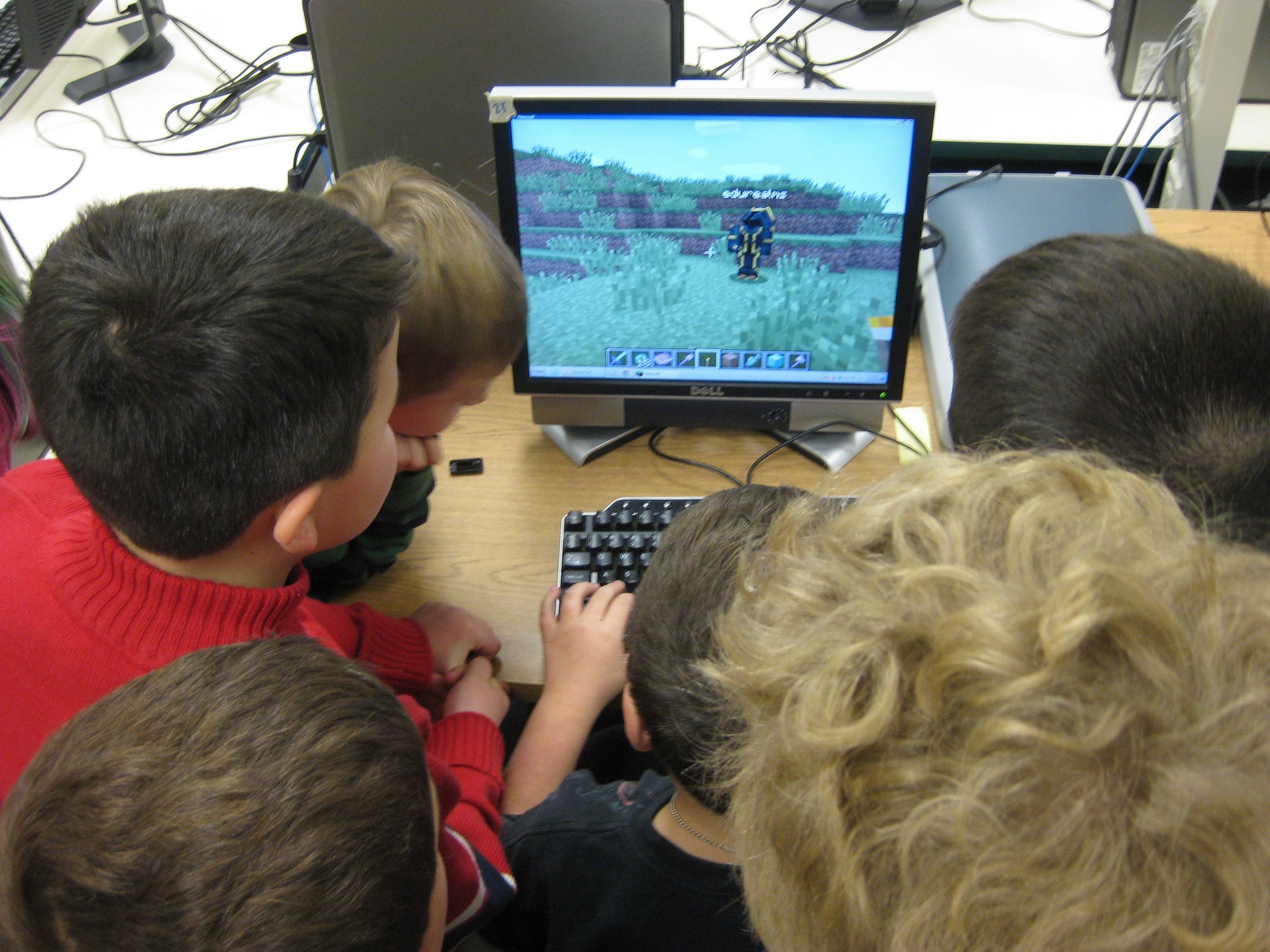
A lot has been mentioned about Minecraft’s benefit in learning. However it’s rare to hear about Minecraft and learning from a students’ point of view. Students are starting to see the potential of combining their love of gaming and the opportunity to learn in a way which is both motivating and relevant. What does the future hold for games like Minecraft? Is it possible that Minecraft will one day be a part of the common core, or government mandated national curriculum?

http://planetivy.com/gaming/43886/minecraft-the-cornerstone-of-future-education/

doctorate education gamification phd pokemon effect triforce

About the Massively @ jokaydia Guild

About the Massively @ jokaydia Guild.

About the Massively @ jokaydia Guild

Massively Minecraft is a kid-friendy (and parent friendly) community with private whitelisted servers for kids to play on. The premise is to give them a safe place to play, as well as providing an opportunity to develop digital skills, explore creativity and develop good online habits and social skills.

The group has been around for about 3 years and boasts a thousand members. Players can progress up the guild’s ranks by taking on tasks and achieving the awards. Doing so gives players increased responsibilities and privileges, while at the same time improving the player’s community skills.

doctorate education gamification phd pokemon effect triforce

The Triforce of Gamer Knowledge

http://www.youtube.com/watch?v=yNZeMKZRIZ4

The Triforce of Gamer Knowledge

Computer games are fun and gaming is an important aspect of digital culture. The best part about computer games is that when we play, we learn!

This video was made as part of my Masters in Education studies at Griffith University, Queensland, Australia.

Full references, citations and the supporting paper can be found here:

http://griffith.academia.edu/DavidSmeaton

Contact me or learn more about my other videos, studies and academic writing.

about.me/davidsmeaton
davidsmeaton.wordpress.com

doctorate education gamification phd pokemon effect triforce

Creating is Learning: Building skills and knowledge through Minecraft

http://www.youtube.com/watch?v=vFuULAE6RfU

Creating is Learning: Building skills and knowledge through Minecraft.

Computer games are fun and gaming is an important aspect of digital culture. The best part about computer games is that when we play, we learn!

This video was made as part of my Masters in Education studies at Griffith University, Queensland, Australia.

Full references, citations and the supporting paper can be found here:

http://griffith.academia.edu/DavidSmeaton

Contact me or learn more about my other videos, studies and academic writing.

about.me/davidsmeaton
davidsmeaton.wordpress.com

Thanks to Notch and Mojang for making such an excellent game. Thanks also to the Minecraft community (particularly /r/minecraft) and the people who have developed original content that I used in my video.

doctorate education gamification phd pokemon effect triforce

Can a kid make a Minecraft server?

Can a kid make a Minecraft server?

I think there’s plenty of evidence that kids, even as young as 11, are capable of making and running their own Minecraft server. 

Perhaps running a server sounds easy, but it’s not quite so simple. It’s obviously easier if you go the “paid” hosting route, which does it all for you. But what about hosting on your own computer? Well, that requires some learning, as one 11 year old boy discovered.

In the pursuit of making his own server, one boy learned about IP addresses, port forwarding and  technical issues that are related to computers and hosting a game server. A lot of valuable skills are learned through the process of ‘figuring it out’. As well, he learned really useful problem solving skills when he was forced to find solutions to unexpected problems.

This is a good example of learning “Beyond the Game”. The game itself is merely the stimulus for further learning (such as computers, internet networking, etc). Broader knowledge is acquired, as are skills related to computers, hardware or problem solving.

Gamers learn a lot, and an 11 year old boy who built his own server, is a good example of that!

doctorate education gamification phd pokemon effect triforce

A People’s History Of The FPS

A People’s History Of The FPS

FPS (first person shooters) is the financial bread and butter of computer game makers. As well, FPS is a benchmark of gaming’s evolution. Despite the industry’s over-saturation of FPS games, some high paced shooters stand out as literal “game changers”.

In the early days of the FPS gold rush, Myst (and sequel Raven) was billed as the game that would define the genre. Instead a rough hack and slash shooter called Doom (released a few months later). Doom followed in the style of the legendary Wolfenstein 3D and became the biggest selling game in the world.

Most importantly, Doom was a highly moddable game. This lends credibility to my own theories about user created content. Because Doom was able to be modified, users could create new versions of the game by remixing other ideas into the Doom style of game. Some good examples are Ghostbusters, Batman and the amazing Aliens mod.

Following the history of first person shooters gives a valuable insight into the way games have evolved. The success of games doesn’t only depend on the game’s quality, content and gameplay. Games which are able to be modified by the user, remixed and shared are games that have more potential to spark gamers’ interests. To me, that’s a crucial element – whether by design or inadvertently, games which can be user-modified are more likely to achieve greater success and longevity.

The rest of the “People’s History of the FPS” is available here:

Part 2 – http://www.rockpapershotgun.com/2012/09/20/a-peoples-history-part-2-the-mod/

Part 3 – http://www.rockpapershotgun.com/2012/09/21/a-peoples-history-of-the-fps-part-3-the-postmod/

Game designers please note – game modability is the key to gaming success.

Teachers please note – when students are modding games, they’re learning!

doctorate education gamification phd pokemon effect triforce

More hate for gamification

More hate for gamification

The problem with “critics” is that they’ve got lots of opinions … but don’t usually contribute anything productive (other than their verbosity) to the discussion. The problem with gamification is that it has become so popular so fast that critics are lining up to take a swipe and feel good about themselves.

Margaret Robinson’s article from 2010 on gamification goes down the same road as many other critics, including Bogost’s scathing attack (mentioned in the previous post). Robinson is determined that gamification focuses on the least important part of the game. She, like Bogost, says that badges and progress points aren’t intrinsic to the game at all.

But she’s wrong … they are important. Gamification isn’t about the game itself. Gamification is about how a game layer (game elements) can be used as motivators. If we look directly at games we can confidently say that games have motivators. One motivation is to win, to be the best. That motivation is represented by a scoreboard (leader boards can be used as a gamifying technique). If there’s no score or no winner, then many will find the game to be less fun.

Let’s make it more clear through an example. I’m a bit of a poker player. I enjoy poker and I play it when I can. It’s possible to play poker without money and without talking to the other players. But doing so would take away most of the fun … it would take away the motivation to play. See, that’s an intrinsic part of gaming. Sometimes the game itself is not that interesting, but socialising and gambling add to the enjoyment. I play poker so that I can experience the adrenaline rush of winning a big hand and, at the same time, talking with friends over a few beers.

Sometimes the game is just a tool. The mechanics of the game are not that important. This is what gamification represents. If we add a game layer to other tasks then we add a motivation. Gamification includes rewards, and it also includes socialising.

http://www.slate.com/articles/technology/gaming/2011/03/i_dont_want_to_be_a_superhero.html

More criticism. This time targeted at gaming guru Jane McGonigal. Through her Tedx talk, McGonigal talks about her heal and some experiences relating to that. Particularly she relates how she used gamification and roleplaying to help her recovery. 

Heather Chaplin, the author of the piece, says that games aren’t that fun and “gaming” isn’t for everyone. This is another common criticism of gaming and gamification – it isn’t a one-size-fits-all solution.

Well, no … of course not! Nobody who is a proponent of gamification is saying such a thing.

The truth is that we all DO play games. We play various games in our daily lives. Some people play cards, some collect coupons or air miles. Some play sport and others play tetris on their smartphone. Everyone plays games … but not everyone plays the same type of game. That’s not the same as saying not everyone finds games appealing, which is a falsehood.

Gamification covers this problem too by acknowledging multiple approaches to motivating people to play. Level up systems, for example, are a combination of small (like an incremental number) and big (like a major “level”). This is important because some people are motivated by different goals. Some people like to see the incremental gains (immediate, short term goals) and others prefer the larger gains (long term goals). Both work together to motivate. The same with leaderboards – global leaderboards motivate those who wish to be the best. Social leaderboards motivate people who want to try and beat their friends. Some people are motivated by certain badges. Others are motivated by completely different goals or achievements such as social status.

A great “real world” example is scouts. Scouts get badges for proving that they have a certain skill. Once they demonstrate a skill they get a patch or badge. The badges give a scout status in the community (global leaderboard) and amongst their friends (social leaderboard). When the scout gets a certain number of badges they can get a promotion (level up). 

All of these ideas are older than the internet and computers. Gamification isn’t creating something new, it’s just identifying systems and motivational strategies that have been around for centuries.

The main criticisms of gamification is that it doesn’t focus on the most important part of the game (ie the actual game) and that games don’t appeal to everyone. 

Complete rubbish! The game and the rewards for playing are equally important. Everyone is motivated by different rewards, so gamification is a multi-faceted approach which acknowledges such. Finally, whether critics want to admit it or not, everyone DOES play games. Grandma may not play shooter games like Call Of Duty, but she does collect the supermarket discount stamps (that’s a game) and she does play bridge on Thursdays (another game). She doesn’t collect stamps because she thinks its fun (it’s not fun at all). She collects the stamps because there’s a reward (free stuff). She doesn’t play bridge because she enjoys the technicalities and math involved in the game. She plays because she can chat with her friends and is motivated to beat them (and win status as a good player).

See, gamification is everywhere. 

It’s too easy to criticise something because it’s popular. It’s much harder to take a more measured approach to understanding that gamification offers real potential in education. Games and gamification are valid tools for motivating people to participate and learn … it’s sad that we still have to fight this war over justifying the place of gaming in our culture.
Scroll to Top